OMRON publishes clear discontinued/recommended-replacement data for many legacy E2E proximity sensors migrating to E2E NEXT, and a full E3Z photoelectric lineup with NPN/PNP counterparts. This guide pulls both together with the checks that decide whether a mapped replacement actually works in your machine.
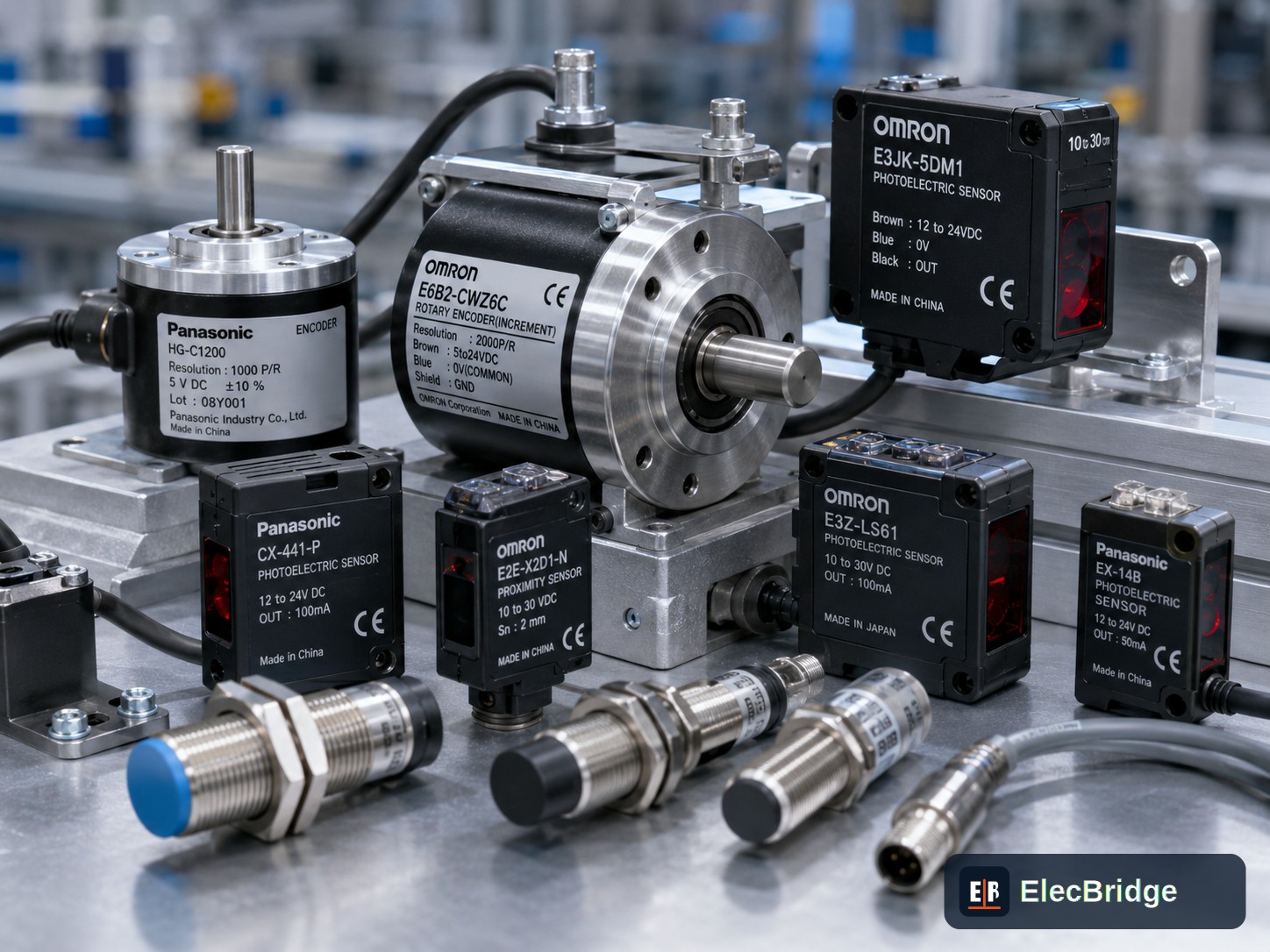
OMRON states that legacy E2E DC 2-wire / 3-wire model groups such as E2E-X...D..., E2E-X...E... and E2E-X...F... have migrated to the E2E NEXT family. For exact discontinued references, OMRON's recommended-replacement database provides model-level successors. Use those official records as the starting point, then verify output type, NO/NC logic, sensing distance, body diameter, shielding, cable or connector, wiring, indicator behavior and the machine input circuit.
Do not replace an OMRON sensor only because the thread size and nominal sensing distance look similar. NPN vs PNP, NO vs NC, shielded vs unshielded, pinout, cable length and connection method can stop the machine even when the sensor physically fits.
| Legacy OMRON model | OMRON recommended successor | Practical check |
|---|---|---|
| E2E-X2E1 2M | E2E-X2C112 2M | OMRON discontinued/replacement database; cable length retained |
| E2E-X2E1 5M | E2E-X2C112 5M | OMRON discontinued/replacement database; cable length retained |
| E2E-X5E1 2M | E2E-X5C118 2M | OMRON discontinued/replacement database; cable length retained |
| E2E-X5E1 5M | E2E-X5C118 5M | OMRON discontinued/replacement database; cable length retained |
| E2E-X5E1-R 10M | E2E-X5C118-R 5M | Robot-cable version; official successor changes cable length |
| E2E-X18ME1 2M | E2E-X18MC130 2M | M30-class official replacement family; verify exact installation |
| E2E-X18ME1-M1 | E2E-X18MC130-M1 | M12 connector model; official recommended replacement |
| E2E-X1R5E1 2M | E2E-X1R5C18 2M | M8-class official replacement; sensing-distance class retained |
A recommended successor is not automatically a drop-in replacement for every installation. The old PLC input, wire colors, connector pinout, indicator logic, mounting depth and nearby-metal conditions still need to be checked.
E2E NEXT includes broad DC 3-wire and DC 2-wire lineups with multiple body sizes and connection formats.
For the current E3Z family, the most useful cross-reference is often not a lifecycle successor table but a model-function table. The following pairs are OMRON lineup counterparts (for example NPN vs PNP or pre-wired vs connector) — not statements that one model is the successor of the other.
| Function / sensing class | NPN model | PNP model | Connection / note |
|---|---|---|---|
| Through-beam, 15 m | E3Z-T61 2M | E3Z-T81 2M | Pre-wired; NPN vs PNP |
| Through-beam, 15 m | E3Z-T66 | E3Z-T86 | M8 connector |
| Retro-reflective with MSR, 4 m* | E3Z-R61 2M | E3Z-R81 2M | Reflector selected separately |
| Retro-reflective with MSR, 4 m* | E3Z-R66 | E3Z-R86 | M8 connector |
| Diffuse-reflective, 5–100 mm | E3Z-D61 2M | E3Z-D81 2M | Wide-view, pre-wired |
| Diffuse-reflective, 5–100 mm | E3Z-D66 | E3Z-D86 | M8 connector |
| Diffuse-reflective, 1 m | E3Z-D62 2M | E3Z-D82 2M | Pre-wired |
| Diffuse-reflective, 1 m | E3Z-D67 | E3Z-D87 | M8 connector |
| Distance-settable | E3Z-LS61 2M | E3Z-LS81 2M | NPN / PNP counterpart |
| Distance-settable | E3Z-LS66 | E3Z-LS86 | M8 connector |
| Clear-bottle retro-reflective | E3Z-B61 2M | E3Z-B81 2M | Application-specific optics |
* Sensing distance depends on the specified reflector and installation conditions.
| Check | Why it matters |
|---|---|
| Exact model string | Keep suffixes, cable length and connector codes. A missing suffix can change the product. |
| Sensor type | Inductive proximity, photoelectric, capacitive, fiber, safety, etc. |
| Output | NPN or PNP; 2-wire or 3-wire; NO/NC; load/input compatibility. |
| Sensing method | Through-beam, retro-reflective, diffuse, BGS/FGS, inductive shielded/unshielded. |
| Distance | Nominal sensing distance plus target material/reflectivity and margin. |
| Mechanical fit | Thread/body size, mounting depth, brackets and connector clearance. |
| Environment | IP rating, oil/water, washdown, temperature, vibration and robot cable requirement. |
| Wiring / network | Cable cores, pinout, M8/M12, Smartclick, IO-Link, input common. |
If the project specification does not require OMRON, a cost-down alternative can be evaluated, but the alternative should be selected from the actual electrical and mechanical conditions rather than from a seller's "same size / same distance" claim.
| Lower-risk candidates | Higher-risk candidates |
|---|---|
| Standard inductive proximity sensing; simple photoelectric presence detection; non-safety applications with accessible commissioning | Safety sensors; high-speed counting; difficult reflective targets; oil/washdown environments; tight mechanical tolerances; IO-Link diagnostics; machines already validated around specific OMRON behavior |
For an OEM batch conversion, validate a sample on the machine before locking the BOM.
Full sensor model number and clear nameplate/body photo · machine application and target material · NPN/PNP and NO/NC requirement if known · supply voltage and PLC/input model · sensing distance and mounting photo · cable length / connector type · quantity and destination country.
OMRON — E2E NEXT Proximity Sensor lineup, ia.omron.com · OMRON — E3Z Compact Photoelectric Sensor lineup, ia.omron.com · OMRON Japan — Legacy E2E family page: selected DC 2-wire / 3-wire E2E groups migrated to E2E NEXT, fa.omron.co.jp · OMRON Japan — Discontinued / recommended-replacement database and technical FAQs used for exact examples: E2E-X2E1 → E2E-X2C112; E2E-X5E1 → E2E-X5C118; E2E-X18ME1 → E2E-X18MC130; E2E-X1R5E1 → E2E-X1R5C18.
Technical Disclaimer: ElecBridge is an independent sourcing service and is not OMRON. Final sensor selection must be verified for the actual PLC input, wiring, target, mounting, environment and machine safety requirements.
Tell us the sensor model and application — get an honest cross-reference assessment within 48 hours. Official OMRON replacement data, and what's worth verifying before you order.
Send your sensor details for a check →